Home / Why iron?
THE SCIENCE, WITH RECEIPTS.
Why iron?
Iron is one of the nutrients people most often run short on. Tea can make that harder. Here's what the research says, and what we did about it.

01 · THE GAP
A lot of people quietly run low on iron.
Adult women aged 19–50 need about 18 mg of iron a day; adult men need about 8 mg. In pregnancy the target rises to 27 mg.1 That gap between what women need and what men need is why iron shortfall is so much more common in women.
Heavy periods, pregnancy, frequent blood donation, endurance training, and diets low in meat all push iron needs up or intake down.1 Common signs of running low include fatigue and reduced exercise capacity, but only a blood test can tell you where you stand.
02 · THE COMPLICATION
Tea and iron have a complicated relationship.
Most of the iron in plants, grains, and supplements is non-heme iron, which the body absorbs less readily than the heme iron in meat. On a mixed diet roughly 14–18% of dietary iron is absorbed; on a vegetarian diet, about 5–12%.1
Tea is rich in polyphenols (including tannins). Those polyphenols bind non-heme iron in the gut. In a controlled trial, black tea taken with a bread meal cut non-heme iron absorption by 79–94%; even herbal teas and cocoa cut it by roughly half or more.2 A 2017 trial in healthy women found tea with a meal reduced iron absorption by about 37%, and that waiting an hour after eating roughly halved that effect.3
Matcha is green tea, ground whole, so it carries the leaf's polyphenols with it. That's part of what makes it good for you. It's also why a daily matcha and a tight iron budget don't automatically get along.
03 · THE HELPER
Vitamin C is the best-documented friend iron has.
Ascorbic acid (vitamin C) enhances non-heme iron absorption, which is why nutrition guidance pairs plant iron with vitamin C-rich foods.1 It's one of the few dietary levers with decades of evidence behind it.
It's not a magic eraser. Lab work suggests vitamin C can offset lower levels of polyphenols but not very high ones,4 so timing and dose still matter. But it is the right ingredient to put next to iron.
THE MATCHA ITSELF
Organic, ceremonial-grade matcha,
harvested in Kyoto.
Real Japanese matcha is where qt starts. Everything else is there to make it taste like fruit and love you back.
Kyoto, Japan
Grown and harvested in Kyoto, the region that has defined matcha for centuries.
Organic & non-GMO
Certified organic leaf. Nothing genetically modified, nothing artificial in the matcha itself.
Ceremonial grade
Vibrant green, milled to a 4–20 micron powder that shakes straight into cold water. No whisk, no clumps.
Tested every lot
Heavy metals and microbiology checked on every single batch by ICP-MS and AOAC methods, in an SQF-certified facility.
Kosher and gluten-free matcha. Produced in a facility that also handles tree nuts, mustard, sesame and celery. Full finished-product ingredient and allergen details will be on the label.
04 · WHAT WE DID
So we put iron, vitamin C, and collagen in the cup.
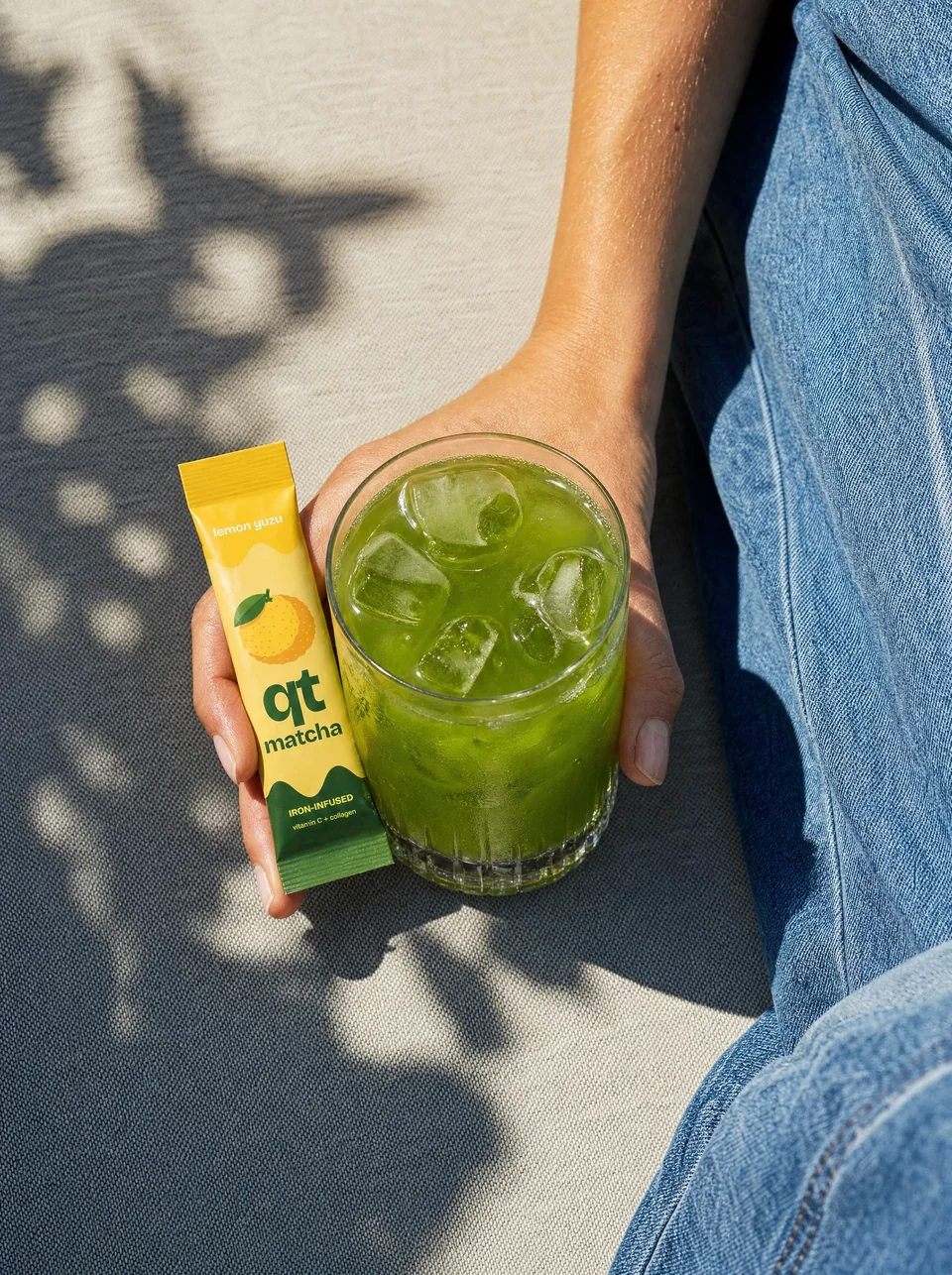
qt is real matcha infused with iron, vitamin C, and collagen. The iron and vitamin C are the pair the research above points to. Collagen is a protein; it's bovine-derived, which is why qt is not vegan, and we'd rather tell you that here than in the fine print.
The forms and amounts of each will be printed on the nutrition panel and published on this site before ordering opens. We're not going to quote milligrams until the panel is final.
What we don't claim: that qt raises your iron levels, treats deficiency, or replaces anything your doctor prescribed. It's a matcha drink built with the science in mind. That's the claim.
05 · THE HONEST PART
Read this before you make qt your daily.
- Not a treatment. If you have persistent fatigue, dizziness, or unusual paleness, see your healthcare provider and ask for a ferritin test. If you take a prescribed iron supplement, keep taking it as directed and share qt's label with your provider.
- There is an upper limit. The tolerable upper intake level for iron in adults is 45 mg per day from all sources.1 Count qt alongside any supplement you already take.
- Keep iron-containing products away from children. Accidental overdose of iron-containing products is a leading cause of fatal poisoning in children under six.1 Store qt where kids can't get it.
- Pregnant or breastfeeding? qt contains iron and caffeine. Talk to your OB or midwife before adding it to a prenatal routine.
- It has caffeine. It's matcha. The amount per serving will be on the panel.
*These statements have not been evaluated by the Food and Drug Administration. This product is not intended to diagnose, treat, cure, or prevent any disease. If you have or suspect an iron deficiency or any medical condition, consult your healthcare provider.
SOURCES
- National Institutes of Health, Office of Dietary Supplements. Iron: Fact Sheet for Health Professionals. RDAs, bioavailability, at-risk groups, tolerable upper intake level, and the pediatric overdose warning.
- Hurrell RF, Reddy M, Cook JD. Inhibition of non-haem iron absorption in man by polyphenolic-containing beverages. British Journal of Nutrition, 1999;81(4):289–295.
- Ahmad Fuzi SF, Koller D, Bruggraber S, Pereira DIA, Dainty JR, Mushtaq S. A 1-h time interval between a meal containing iron and consumption of tea attenuates the inhibitory effects on iron absorption. American Journal of Clinical Nutrition, 2017;106(6):1413–1421.
- Ma Q, Kim EY, Lindsay EA, Han O. Bioactive dietary polyphenols inhibit heme iron absorption in a dose-dependent manner in human intestinal Caco-2 cells. Journal of Food Science, 2011;76(5):H143–H150. (Cell study; cited only for the vitamin C / polyphenol dose interaction.)
Now, the fun part.
Three flavors. One daily qt.
Find your flavor →